Are wolves feasting on cattle? UC Davis study shows their diet of livestock
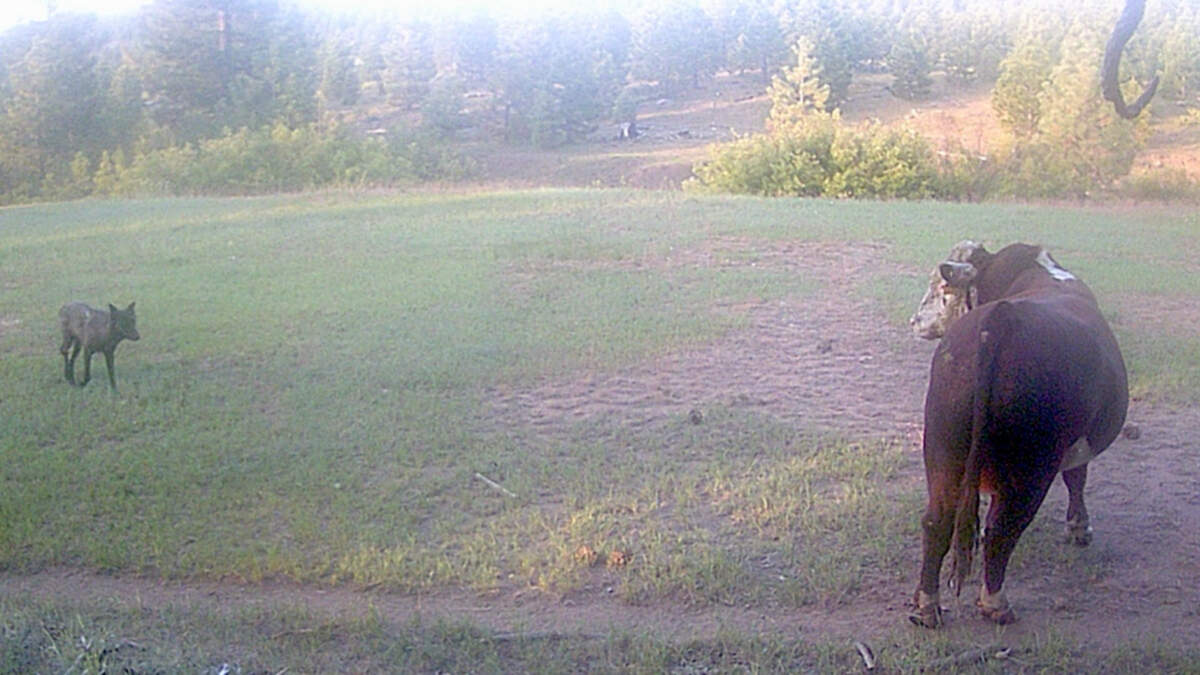
Cattle sent to the state’s high rangeland for summer grazing comprised the majority of food eaten by wolves in Lassen and Plumas Counties over a two-year period, a study published Wednesday by researchers at UC Davis says.
DNA from cattle was found in 72% of wolf scat samples gathered during the summers of 2022 and 2023, and accounted for more than half of the volume or “biomass” that the animals ate, the peer-reviewed research shows. The wolves’ traditional prey, mule deer, was found in just 45% of the samples.
Cattle make up such a large portion of the diet of the wolves in the study that one of the researchers, agricultural economist Tina Saitone, argues that the animals — once locally extinct in California — are recovering because of the availability of livestock for food.
“Essentially, the cattle industry in California is really supporting the conservation success of wolves,” Saitone said in an interview. “There are multiple problems that are creating a situation where wolves are highly dependent on cattle to save themselves.”
The results, which confirm preliminary findings by the researchers that drew criticism last year from wolf advocates, do not indicate whether wolves killed the cattle outright or simply scavenged the meat. But they are sure to add to growing debate over the state’s struggle to balance conservation of California’s recovering population of wolves with protections for people, pets and livestock.
Wolves were locally extinct in California for nearly a century, hunted by ranchers, law enforcement and others until the last one, starving and missing a leg, was captured in Lassen County in 1924. The return of the predator canines in 2011 — with the arrival of an Oregon male known as OR-7 — set off a wave of interest and celebration as Californians watched his movements on trail cameras and made plans to protect and conserve the animals.
But wolves had been missing from California’s landscape for so long that communities and businesses, including ranches, developed in areas where they once roamed, bringing generations of people, wildlife and domestic animals with no experience in managing or confronting them.
Some packs were now drawn to areas now heavy with livestock, killing cattle and sheep or scavenging upon carcasses of animals that had died. Their status as endangered species under both federal and state laws made it illegal to harass or kill them, limiting actions that residents could take against rogue animals and alarming local law enforcement.
In 2025, a single pack in the Plumas and Sierra counties, dubbed Beyem Seyo, killed nearly 100 cattle in about seven months from March to October, costing ranchers and the state millions and leading wildlife officials to euthanize four wolves.
California has not fully funded a program meant to help ameliorate human-wildlife conflict for years, and the state’s top environmental official, Natural Resources Secretary Wade Crowfoot, called the situation a crisis at a legislative hearing in January.
Worries about the state’s ability to manage other predators, including mountain lions and bears, have added to the anxiety. A recent proposal to study the reintroduction of grizzly bears, has also prompted interest and concern.
Combing rural roads for wolf scat
The wolf scat study, authored by Saitone, her late husband, watershed scientist Ken Tate, and ecologist Benjamin Sacks was published in the journal PLOS One, an open science journal run by an organization formerly known as the Public Library of Science. It was funded by UC Davis and the California Cattle Council.
For it, the group gathered wolf droppings from June through October in Southern Lassen and Northern Plumas Counties inhabited by the Lassen Pack and later the Harvey Pack. Unlike previous studies, which examined bits of hair and bone fragments in wolf scat to determine what the animals ate, the UC Davis researchers used DNA analysis to determine the makeup of the samples.
They collected the scat opportunistically, meaning as they came across it, along rural roads and animal trails. Samples were then tested to make sure they came from wolves, and to see what was in them.
In 2022, 86% of the wolf scat samples contained cattle, the study showed, accounting for about 60% of their diet. The following year, the samples showed a somewhat smaller consumption of meat from cows. Cattle showed up in 55% of fecal samples in 2023, and accounted for 50% of their diet.
By comparison, DNA from mule deer appeared in 38% of samples and comprised 8% of their diet in 2022. The following year, mule deer, wolves’ more traditional prey, showed up in 55% of scat but made up only 15% of their total diet, the study showed.
Taken together, data from the two-year period shows evidence of cattle consumption in nearly three-fourths of the samples, making up 55% of the wolves’ total diet, the researchers said.
“Even if you look at 2023 in isolation, more than 50% of their diet is cattle,” Saitone said. “That is substantially larger than many other places in the world, and almost everywhere else in the United States.”
The findings mark an increase over a previous study by the California Department of Fish and Wildlife on the summer diet of wolves. That report, released in 2021, found hair, bones and other indications of cattle in 32% of wolf scat samples collected during the summers of 2017, 2018 and 2019, compared to 51% from deer.
Prior to their local extinction in the 1920s, gray wolves in California subsisted mostly on mule deer and elk, state biologists say. But the population of mule deer has been steadily decreasing since the 1970s, leading some scientists to theorize that the newly resurgent wolves are relying on other prey, including beavers, rabbits and livestock, the 2021 report states.
The presence of wolves also causes stress among cattle, which can cause difficulty with reproduction, growth and health, Saitone said, pointing to a related study published in the Journal Ecology and Evolution in April. In that study, led by Saitone, the group studied hair samples from cattle exposed to wolves and compared them with herds that were isolated from the predators.
They found higher levels of the stress hormone cortisol in the hair of two out of three herds exposed to wolves, but in none of the cattle that had no interactions with the wild canines.
The study controlled for several stressors, including temperature, Saitone said, as thousands of cows and their calves made their annual summer sojourn in the high rangeland north of Truckee.
Both studies, she said, invited additional research, to tease out more information about the interactions of cattle and wolves, and their implications for policy in California.
Is it fair to blame the wolves?
UC Davis released preliminary results by Tate and Saitone last year amid the widespread furor over the Beyem Seyo pack’s attacks on cattle. Environmentalists fought back, saying that the data had not been reviewed and that wolves might have scavenged the meat rather than killed the animals.
Working with the Center for Biological Diversity, 18 scientists sent a letter to UC Davis Chancellor Gary May and others criticizing the release of preliminary data and questioning estimates of the cost to ranchers of predations by wolves that were not part of the scat and cortisol studies.
Amaroq Weiss, the organization’s senior wolf advocate, welcomed the peer-review process for the scat and cortisol studies. But she raised questions about the methodology used and conclusions drawn.
For example, Weiss said, collecting scat along roads and trails does intersect with where wolves like to travel. But it avoids the wild, brushy areas where they also go. Scat from such areas, far away from ranches and grazing land, might show that the wolves had a diet made up of smaller prey found off the beaten path.
“You’re excluding a lot of wolf scats you should have collected by only collecting wolf scats along their easiest travel corridors,” Weiss said.
Moreover, she said, the 2023 data shows cow and mule deer DNA in an equal number of scat samples, a far less dramatic result than the prior year.
The study also has no way to show how much of the wolves’ cattle consumption came from scavenging the carcasses of dead animals, Weiss said.
“We already do know that the large majority of cattle and calves die from other causes, so you can more safely make the assumption that many of that scat containing cattle DNA came from cattle that were scavenged on,” she said.
Predators accounted for 2% of deaths among adult cattle and 11% among calves, according to a 2015 report by the U.S. Department of Agriculture.
Weiss also questioned the presence of wolves causing cortisol levels to spike in the cattle. For example, she said, the herd could have been stressed because of the management techniques used by ranchers or from the move to the summer grazing lands.
Different management techniques as well as the introduction of cattle breeds that are more aggressive in dealing with predators could also help ranchers with herds in areas where wolves also live, she said.
To a degree, the wolves that migrated from Oregon and Washington to California when OR-7 and others arrived may have already learned that they could survive by preying on cattle, said Rick Roberti, who is president of the California Cattlemen’s Association and has a ranch in the area.
But that doesn’t mean that all the nearby wolves are doing that, he stressed.
Since wildlife officers removed three adults and one juvenile member of the Beyem Seyo pack last fall, the number of predations has dropped dramatically, Roberti said — “like night and day.”
“We have wolves around,” he said. “We had one here the other day. They’re just not the killing type.”
This story was originally published July 8, 2026 at 11:01 AM with the headline "Are wolves feasting on cattle? UC Davis study shows their diet of livestock."