After ‘contentious, difficult’ redistricting process, Merced leaders narrowly approve new map
.JPG "The Civic Center in Merced on 18th and N streets.")
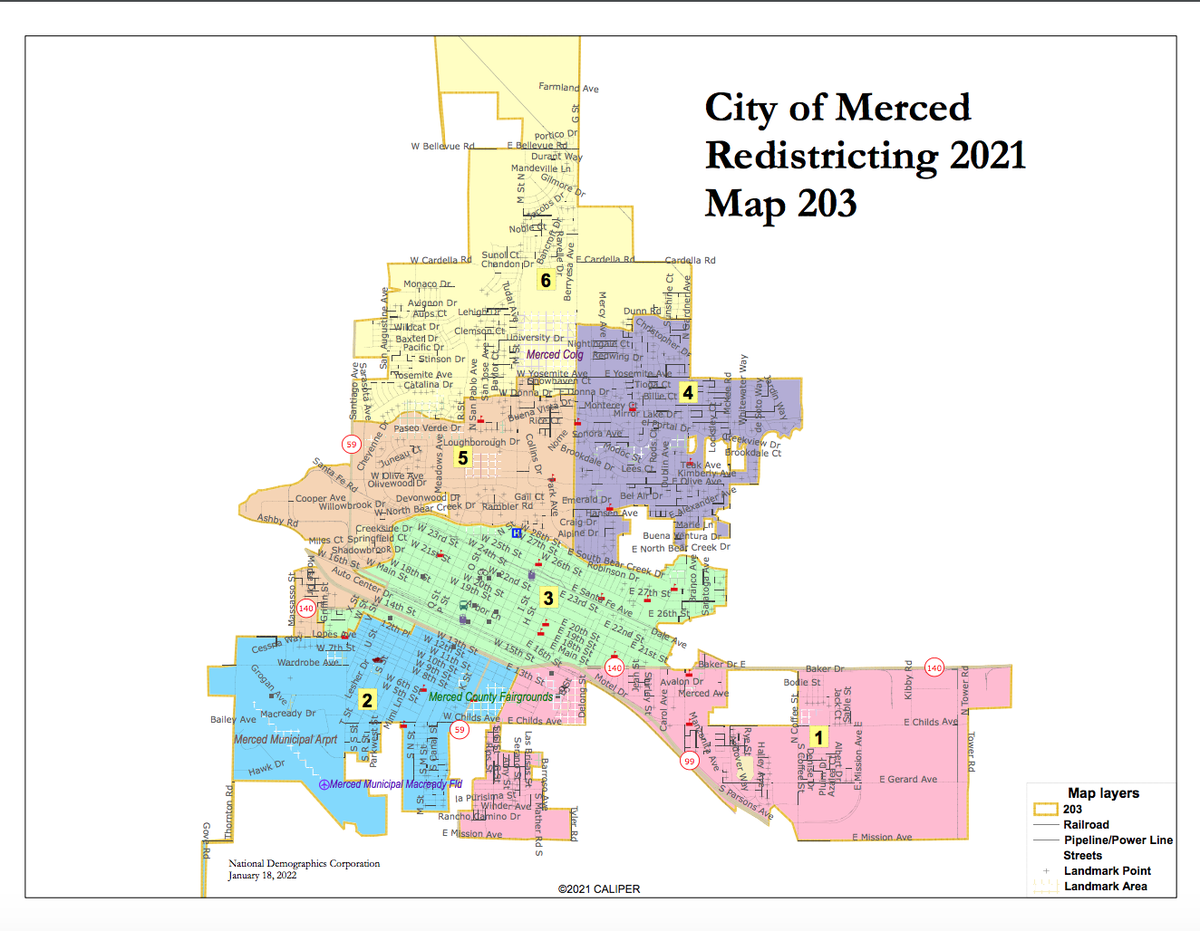
New district lines were drawn for the City of Merced late Monday night, as members of the City Council narrowly endorsed updated boundaries via a 4-3 vote.
The new map is the culmination of the city’s redistricting process, which takes place every 10 years after the latest U.S. Census data is collected. Monday’s decision signaled the end of a community effort that kicked off in June 2021.
“We understand that this is a contentious, difficult process,” Merced Mayor Matt Serratto said at the start of the debate. “Argue passionately for your side. We’re just here to pick the best map.”
Merced City Council’s split vote came after hours of fervent testimony from residents and elected officials alike. Of 12 different draft maps up for consideration, community members mostly debated the merits and drawbacks of two different proposals.
Ultimately, Serratto was joined by council members Kevin Blake, Delray Shelton and Sarah Boyle in voting for map 203. Councilmembers Fernando Echevarria, Jesse Ornelas and Bertha Perez’s cast “no” votes for map 203, each noting their preference for draft map 106.
The majority vote for map 203 was supported by advocates who said its boundaries made more sense than others, in part due to better lines drawn around downtown Merced. Other said they trusted the Redistricting Committee’s recommendation, which promoted map 203 as one of the best options.
There’s little surprise that the map boundaries elicited such impassioned debate Monday, as the stakes those maps represent are high. Redistricting is crucial to a fair democratic process by reflecting a jurisdiction’s changing demographics over the last decade and determining how city, county and state electoral districts will be mapped over the next 10 years.
The process also informs how local and state governments allocate resources across jurisdictions, which affects who voters see on their ballots and ensures each district is represented fairly in elections.
The U.S. Census Bureau reported in its most recent count that Merced County’s population went up by 9.9% since 2010, bringing total residents to 281,202 — 86,681 of which live in the City of Merced. New district boundaries, according to federal law, must parse residents into roughly the same amount of people in each district, meaning roughly 14,447 Merced residents should reside in each of the city’s six districts. .
Maps must also be free of racial gerrymandering and should be compact, geographically continuous, keep neighborhoods and communities of interest together, and have easily identifiable boundaries, according to state and federal law.
Why new Merced district map was chosen — and why some disagree
Over three dozen Merced residents from all of the city’s six districts pleaded their case to the City Council late Monday night. Nearly all spoke in support of either map 203 or 106.
Draft map 203 was one of two proposals recommended to the City Council by the Merced Redistricting Advisory Committee. The committee, made up of nine community members, was formed last year to advise elected officials in choosing a new district map.
The other committee-recommended map, numbered 107, was dismissed mostly due to splitting up north Merced’s Loughborough neighborhood between two districts.
While draft map 106 was not endorsed by the committee, it still met state and federal requirements for district lines and proved popular among many Merced residents.
Nicknamed the “Merced Forward Together” map, its lines were championed by organizations Power California and Communities for a New California. Proponents said it would keep communities whole, promotes little population deviation between districts and take the growth of District 6 in north Merced into account.
Some critics of map 106 pointed to the organizations supporting it as indication that “outsiders” were pushing for those district lines.
Several Merced residents fired back against those accusations by voicing their endorsement of 106. “It’s a really exciting map. It’s a map that has taken community input from every district into consideration,” Merced resident Noelle Anderson said of draft map 106 at Monday’s council meeting.
Map 106 advocates also pointed to it as the best representation for people of color in Merced and noted that it would create three districts with a Latino citizen voting age population over 50%.
“It reflects community needs and will give Black and Latinx communities a stronger unified voice,” Merced resident and Power California organizer Lizeth Calderon said of map 106 in an opinion submission to the Sun-Star this week. Many residents and several City Council members echoed these points in their support of map 106.
But those opposed to map 106 criticized proponents as overemphasizing the importance of race.
“I think focusing on race is just going to continue to divide the city,” Blake said, noting that racial gerrymandering is discriminatory and inappropriate in the redistricting process. “I think we need to stop with the race-mongering and the division.”
Shelton and Boyle reiterated Blake’s comments about race, each adding that map 203’s district lines made more sense.
“It’s close, but it’s a superior map,” Serratto said before casting his vote for map 203.