Is hateful political rhetoric rising in Merced? Civic leaders answer
AI-generated summary reviewed by our newsroom.
- Officials disagree whether rising rhetoric equals increased hate or mere anger.
- Merced leaders report increased political engagement since 2020 pandemic.
- Public officials observe online discourse escalates faster than face-to-face exchanges.
Mayor Matthew Serratto and most Merced City Council members said they have observed an increase in political engagement since the 2020 COVID-19 pandemic, but differed on whether hateful rhetoric is on the rise.
“We’ve seen the country become increasingly polarized,” said Christopher Ojeda, associate professor of political science at UC Merced. “Both sides are sort of framing this current political moment as… really high stakes…being on the precipice of catastrophic outcomes. And I think that sort of makes people feel like, maybe…the regular means of participation...through which we express our voice in a democracy just aren’t sufficient anymore, and more drastic means are…needed.”
Serratto said he believes public discourse has become more civil since 2020 when protests erupted across the country after George Floyd was killed by a Minneapolis police officer. He recalled groups advocating passionately to the Council.
“It seems calmer now than it was a few years ago,” Serratto said. “Coming out of COVID and you know, coming after George Floyd… there [was] a lot of unrest nationwide, and…a lot of it in Merced.” There were several protests in the county which, while mostly peaceful, were tense due to confrontations between people protesting the police and those in support of the police.
Council member Mike Harris and county supervisors Josh Pedrozo and Scott Silveira agreed the tone of public discourse has calmed down since then.
“I think it’s actually gotten better. This council works together… we may disagree on things, but we discuss them civilly and reach consensus” said Harris.
Council member Shane Smith said he saw the tone of public discourse shift in 2020 during the COVID-19 pandemic but expressed concern that pre-pandemic norms haven’t returned. “For some, I think they feel like the …guardrails are off and they can do whatever they want,” Smith said.
He recalled incidents in 2020 and 2023 in which, “things have gotten heated and out of control.”
Before serving on City Council, Smith was a member of the Merced City Unified School District board. He said that in both roles he was personally attacked for his views.
“The tone was ‘reel back and say whatever you want,’” said Smith, who recalled being called a “murderer” and told he was “being callous to teachers’ lives” for being in favor of keeping schools open during the early pandemic.
“We’re all on Zoom right,” said Smith, describing the incident, “The executive chair of the local teachers union is basically screaming at me and calling me… names, and then she’s invoking my daughter, who, at that time, was a student in her school.”
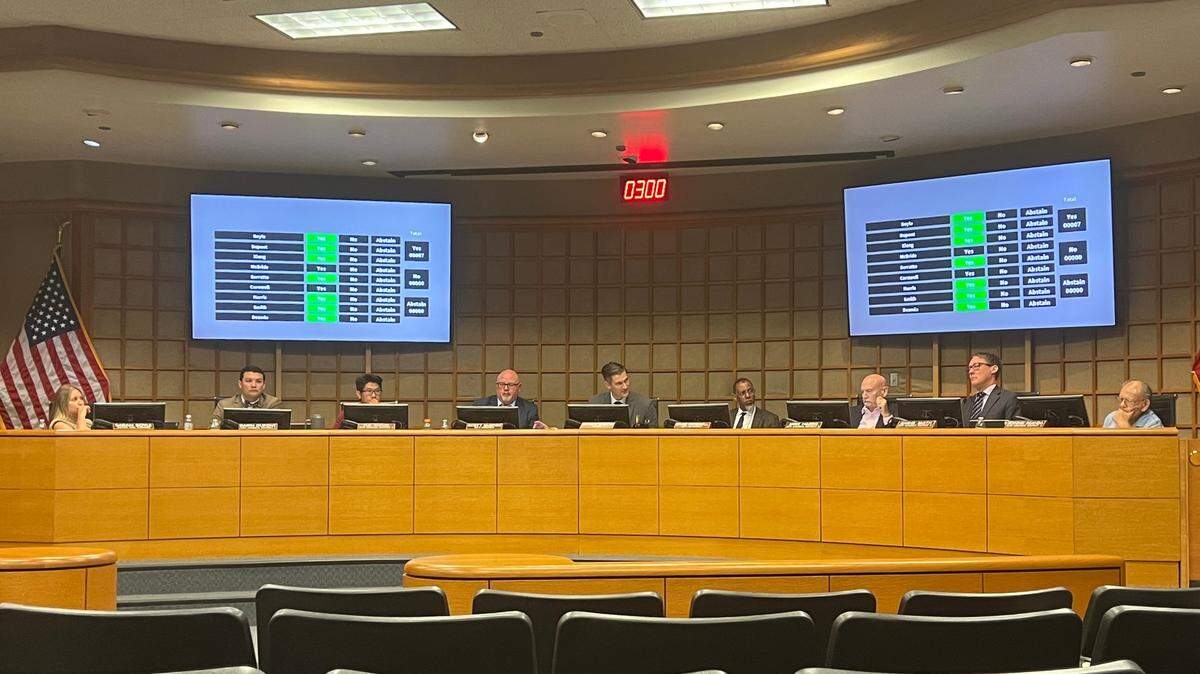
On City Council, Smith said he has been on the receiving end of hostility from both the public and other council members. He pointed to the example of a council meeting on Dec. 18, 2023 which became extremely heated during a discussion about whether the city should adopt a resolution in support of a ceasefire in Gaza.
That meeting involved more than two hours of public comment regarding the ceasefire resolution. Attendees brought signs including a series of signs that read “The blood will be on your hands.” Smith referred to the extensive public comment as “self-defeating.”
Xiong, who proposed the resolution, said before the final vote, “The folks up here that are not willing to take a stance against genocide are the same people that would’ve not...taken a stance to stand for women’s rights, that would not have ended slavery, would have not freed our Black and brown people. They’re the same people, and we know that.”
When the council voted 4-2 to reject the resolution members of the public erupted into chants of “Free, free Palestine!” Serratto shouted at attendees to be quiet before calling a recess.
Xiong recalled the meeting and emphasized the importance of ensuring “that we tackle the tough conversation.” He said he does not see an issue with swearing at City Council meetings as long as the rhetoric isn’t “words of direct threats.”
He said he worried that insisting on a particular tone of civil conversation might advantage some Mercedians over others.
“If people are using words that…are very formal and nice and so forth…they’re allowed to undermine the rest of the community, whereas…folks that show up, that are angry, that are upset, that typically tend to be younger…the words they use are to express their frustration. And I definitely don’t see anything wrong with that.”
“Swearing is, you know, it’s not a big deal to me,” Ojeda said, noting that everyone draws the line of what is appropriate in a different place. “I think that for me…[the line is any] threat to bodily integrity.”
He noted, “swearing is an escalation of rhetoric, right?..[and] you probably don’t jump from like, civil discourse right into … threatening one another…there’s… many steps along the way and swearing might be one of them.”
Across the board, officials in Merced said the tone of public discourse is significantly more hostile and heated online than it is in face-to-face conversations.
“When they’re online, it’s definitely more opinionated, and it’s like they almost have…a higher confidence of not thinking there’s going to be any retribution,” said District 3 Supervisor Daron McDaniel.
“I believe some of it has to do with ...just the nature in which people now have this 24-hour news cycle. You have this anybody can get online at any time,” said Silviera, “back before social media...you could have…a one-off conversation with your local elected official…now it’s all instant.”
This story was originally published October 23, 2025 at 10:00 AM.